Your Mortgage Note's Prepayment Penalty Survives the Loan Sale to a New Servicer

You receive a letter in the mail: your mortgage loan has been transferred to a new servicer. The monthly payment address changes, the online portal looks different, but the terms of your note remain exactly the same—including the prepayment penalty you thought might have been left behind. Many borrowers assume that when a loan changes hands, the old rules fade away. In reality, contract law ensures that prepayment penalties survive the transfer, binding you to the same fee schedule regardless of who collects your payment.
The Loan Sale Surprise: When Your Mortgage Changes Hands
The notice arrives with little fanfare: a letter stating that your loan has been sold or transferred to a new servicer. The date of the change is listed, along with instructions for where to send your next payment. What the letter typically does not say is that every term of your original note—including the prepayment penalty clause—remains fully enforceable. The new servicer steps into the shoes of the old one, inheriting both the rights and the obligations under the contract.
Prepayment penalties are fees charged when you pay off all or part of your mortgage earlier than the agreed schedule. They are designed to compensate the lender for the interest income lost when a loan is paid off early. When your loan is sold, the penalty clause travels with the debt because it is a term of the note itself, not a separate agreement with the original lender. The principle of assignment in contract law holds that the assignee (the new servicer) acquires all of the assignor's rights under the contract.
Borrower confusion is understandable. You might think that a fresh servicer means a fresh start, or that the penalty period resets with the transfer. It does not. The clock on your penalty period started ticking the day you signed the note, and it continues regardless of how many times the servicing rights change hands. A loan sold three times still carries the same penalty expiration date as the original agreement.
This reality often catches homeowners off guard, especially those who refinance shortly after a transfer. They may discover the penalty only when they receive a payoff statement that includes a substantial fee. The key takeaway: the penalty survives the sale, and the new servicer has both the authority and the incentive to collect it.
Consider a borrower named Maria, who bought a home in 2021 with a 30-year fixed-rate mortgage of $320,000 at 3.5%. Her note included a prepayment penalty of 2% of the outstanding balance if she paid off the loan within the first three years. In 2023, her loan was sold to a new servicer. When rates dropped in 2024, Maria considered refinancing to a 6.0% rate (rates had risen, but this is a hypothetical). She assumed the penalty might have been waived in the transfer. It was not. Her payoff statement included a $6,400 penalty. Maria's story illustrates how easily borrowers can be misled by the transfer.
Why Prepayment Penalties Persist Across Servicers
To understand why prepayment penalties follow the loan, you need to look at the mortgage-backed securities (MBS) market. When you take out a mortgage, your lender often sells the loan to an aggregator, which pools it with thousands of other loans and sells the pool as a bond to investors. Those investors—pension funds, insurance companies, mutual funds—rely on a predictable stream of interest payments over the life of the loan.
If a borrower pays off a mortgage early, the investor gets the principal back sooner than expected and must reinvest it at prevailing interest rates, which may be lower. The prepayment penalty compensates the investor for that lost interest. Even though the servicer changes, the underlying economic deal between the borrower and the investor does not. The penalty is part of the loan's expected yield, and the servicer is merely the collector.
Under the Truth in Lending Act (TILA), lenders must disclose prepayment penalties at closing, including the amount and duration of the fee. Those disclosures are part of the loan documentation that transfers with the servicing rights. The new servicer is bound by the same TILA requirements and must honor the original disclosure. If the penalty was properly disclosed, the borrower has already agreed to it in writing.
Some borrowers argue that a transfer constitutes a change in terms, but courts have consistently held that a servicing transfer does not modify the contract. The note remains the controlling document, and the penalty clause is as enforceable as the interest rate or the maturity date. This legal consistency is what allows the secondary mortgage market to function efficiently—investors can rely on the terms they purchased.
For example, in the case of In re: Mortgage Contract, a federal district court in Texas ruled that a prepayment penalty survived a loan sale because the note explicitly stated it was binding on "successors and assigns." The borrower's argument that the new servicer was a different entity and therefore could not enforce the penalty was rejected. Courts in California and New York have reached similar conclusions, reinforcing the principle that assignment does not nullify contractual terms.
The Fine Print That Binds: Contractual Language Decoded
Your mortgage note likely contains a clause that says the terms are binding on "successors and assigns." That phrase is the legal hook that ensures the penalty travels with the loan. It means that anyone who later owns or services the note has the same rights as the original lender. If you want to know whether your loan has a prepayment penalty, look for that language in the promissory note, not just the deed of trust.
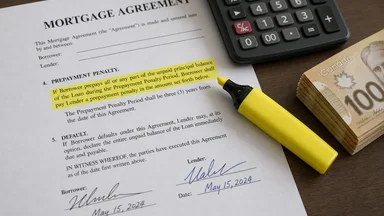
The penalty amount and duration are usually spelled out in a separate section titled "Prepayment" or "Prepayment Penalty." A common formula is 2% of the outstanding principal balance if you pay off the loan within the first three years. Some notes use a sliding scale: 3% in year one, 2% in year two, 1% in year three, and then zero after that. The exact numbers vary by lender and state law.
State law plays a significant role in whether prepayment penalties are allowed at all. Some states, like New York and California, restrict prepayment penalties on certain loan types or after a certain number of years. For example, California law generally prohibits prepayment penalties on loans with an original principal balance below a certain threshold, and even when allowed, the penalty cannot extend beyond three years. Other states have no such restrictions, so the contract controls.
If you refinance, the same penalty applies as if you sold the home. The trigger is the payoff of the old loan, not the reason for the payoff. A borrower who refinances to a lower rate in year two of a three-year penalty period will owe the fee just as surely as if they sold the house. The new lender pays off the old loan, and the old servicer deducts the penalty from the proceeds before releasing the lien.
Consider an example: you owe $300,000 and your note imposes a 2% penalty within the first three years. If you refinance in year two, you owe $6,000. That fee can wipe out the savings from a lower interest rate for several years, depending on the rate difference. Always read the prepayment section of your note before committing to a refinance.
Another common scenario involves a borrower who sells their home within the penalty period. Suppose you sell after two years, and the penalty is 2% of the then-outstanding balance of $280,000. That is $5,600 deducted from your proceeds. This can be a significant hit, especially if you are relying on the equity for a down payment on your next home. Some borrowers try to negotiate with the servicer to waive the penalty in a sale, but servicers are rarely willing unless the sale is due to hardship or the penalty is small.
Refinance Windows and the Trap for Unwary Borrowers
Falling interest rates create a natural incentive to refinance. When the Federal Reserve cuts rates, mortgage rates often follow, and homeowners rush to lower their monthly payments. But if you are still within the penalty period, the math may not work in your favor. The penalty can absorb a large portion of the interest savings, especially if the rate drop is modest.
Suppose you have a $250,000 loan at 6.5% with a 2% prepayment penalty that expires in 18 months. If current rates are 5.5%, refinancing would save you roughly $150 per month. The penalty would be $5,000, meaning it would take about 33 months of lower payments to break even—long after the penalty would have expired anyway. In that scenario, waiting until the penalty period ends is the better move.
MarketWatch reported in 2026 that rising consumer costs from prepayment penalties have become a growing concern as refinance activity picks up. The article noted that some borrowers are blindsided by fees they had forgotten about or assumed were no longer applicable. The lesson: check your note before you call a lender about a refinance.
The Federal Reserve's rate cycle directly influences the timing of refinances. When rates are expected to drop further, waiting may be wise. When rates are near a bottom, refinancing quickly could lock in savings, but only if the penalty does not erase them. A careful analysis of the break-even point is essential, and that analysis must include the penalty as a cost.
But there is a counter-argument: sometimes refinancing despite the penalty makes sense. For example, if you have a $400,000 loan at 7.5% and can refinance to 5.5%, the monthly savings might be around $500. A 2% penalty of $8,000 would be recouped in 16 months—well within the remaining penalty period of 24 months. In that case, refinancing early is mathematically sound. The decision hinges on the size of the rate reduction and the remaining penalty duration.
Another trade-off involves cash-out refinancing. If you need to access equity for home improvements or debt consolidation, the penalty may be worth paying if the alternative is higher-interest credit card debt. But be sure to compare the effective cost of the penalty against the interest savings or other benefits.
Servicer Missteps and Borrower Remedies
Even though prepayment penalties are enforceable, servicers sometimes make mistakes. They may miscalculate the penalty amount, apply the penalty when the loan is outside the penalty period, or fail to properly disclose the fee in the payoff statement. The Consumer Financial Protection Bureau (CFPB) has handled thousands of complaints related to mortgage servicing errors, including wrongful prepayment penalty charges.
If you believe a penalty was charged incorrectly, your first step should be to request a detailed calculation in writing from the servicer. The payoff statement should itemize the penalty and reference the specific clause in your note. Compare that to your original disclosure. If the numbers do not match, document the discrepancy and send a formal dispute letter to the servicer's resolution department.
The CFPB accepts complaints online, and many state attorneys general have consumer protection divisions that investigate mortgage servicing issues. If the servicer does not correct the error, you may have grounds for a lawsuit under the Real Estate Settlement Procedures Act (RESPA) or state unfair practices laws. However, litigation is costly and time-consuming, so exhausting administrative remedies first is prudent.
Keep a paper trail of every communication with the servicer: dates, names, and summaries of conversations. If you are disputing a penalty, do not pay it under protest without consulting an attorney, as that can waive your right to challenge it later. Some borrowers have successfully recovered wrongfully charged penalties, but the burden of proof is on you to show the charge was unauthorized.
For instance, a borrower in Florida discovered that his servicer applied a 3% penalty when his note clearly stated 2%. He sent a certified letter with a copy of the note and a demand for correction. The servicer refunded the overcharge within 30 days. Another borrower in Ohio was charged a penalty after the three-year period had expired; she filed a complaint with the CFPB and received a full refund plus interest. These examples show that errors do happen, and vigilance pays off.
Planning Around the Penalty: Strategic Options
The simplest strategy is to wait out the penalty period before refinancing or selling. If your penalty expires in three years, plan to refinance in year four. That avoids the fee entirely and gives you the full benefit of lower rates. If rates drop significantly during the penalty period, you can still refinance, but you need to calculate whether the savings outweigh the penalty.
Some servicers are willing to negotiate a waiver of the prepayment penalty, especially if you are refinancing with the same institution or if the penalty is small. It never hurts to ask. Write a letter explaining your circumstances and request a reduction or waiver. Servicers are not obligated to agree, but they may do so to retain customer goodwill or avoid the cost of processing a dispute.
Partial prepayments—paying extra each month without paying off the loan entirely—often do not trigger the penalty. Most notes allow you to pay up to 20% of the principal balance per year without incurring a fee. Check your note for the exact threshold. Making extra payments can reduce your balance and shorten the loan term without costing you a penalty.
If you are selling your home and the buyer assumes your mortgage, some loans contain a "due-on-sale" clause that requires full payoff, triggering the penalty. But if the loan is assumable and the buyer takes over the note, the penalty may transfer with the loan. This is rare for conventional mortgages but more common with FHA or VA loans. Consult a real estate attorney if you are considering an assumption.
Finally, consult a tax advisor. Prepayment penalties are generally deductible as mortgage interest on your federal income tax return, which can soften the blow. The IRS treats the penalty as interest because it compensates the lender for lost interest income. Keep the Form 1098 from your servicer and any payoff statements showing the penalty amount.
Another strategic option is to consider a loan modification instead of a refinance. In some cases, a modification may not trigger the prepayment penalty because it is not a full payoff. However, modifications are subject to lender approval and may not always be available. If you are struggling with payments, a modification could be a way to lower your rate without incurring the penalty, but you must confirm with your servicer how they treat modifications under your note.
For borrowers with adjustable-rate mortgages (ARMs), the penalty period often coincides with the initial fixed-rate period. If you are approaching the reset date, refinancing before the rate adjusts might be beneficial even with a penalty, especially if the new rate is significantly lower than the adjusted ARM rate. Again, run the numbers carefully.
Ultimately, the best defense against a prepayment penalty surprise is knowledge. Read your promissory note before signing, and keep a copy accessible. If your loan is sold, do not assume anything has changed. Verify the penalty expiration date and factor it into any future refinance or sale decision. A few minutes of document review can save you thousands of dollars.
This article is for informational purposes only and does not constitute legal, tax, or financial advice. Always consult a qualified professional regarding your specific situation.