How a Brokerage’s Order Routing Fee Skims Your Trade Before It Reaches the Exchange

When you hit "buy" on your brokerage app, you probably imagine your order flying to the New York Stock Exchange or Nasdaq, where it competes with thousands of other buyers and sellers. That is almost certainly not what happens. Instead, your order is likely routed to a private wholesaler—a firm like Citadel Securities or Virtu Financial—that pays your brokerage for the privilege of executing it. That payment is the order routing fee, and it is a hidden cost that nibbles at your returns before your trade ever reaches a public exchange.
The Hidden Toll You Pay Before Your Order Lands
Retail orders rarely hit lit exchanges directly. According to data from the Securities and Exchange Commission, roughly 90% of retail marketable orders are internalized by wholesalers. The process works like this: your brokerage receives your order, sends it to a wholesaler (often the highest bidder for the flow), and the wholesaler executes the trade from its own inventory. The wholesaler pays the brokerage a few fractions of a cent per share for that order flow—that is the routing fee.
The fee is embedded in what is called "price improvement." The wholesaler guarantees to execute your order at a price at least as good as the National Best Bid or Offer (NBBO). In practice, the improvement is often a tiny fraction of a cent—a tenth of a penny per share, for example. That improvement is real, but it is also the vehicle through which the wholesaler extracts its profit. The wholesaler captures the spread between the bid and ask, and the fee it pays the brokerage comes out of that spread.
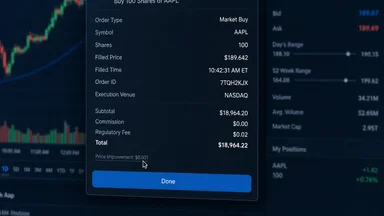
For the retail investor, the cost is invisible. You never see a line item labeled "order routing fee." Your trade confirmation shows a net price, and you may see a notation like "price improvement: $0.001." The fee itself is buried in the wholesale payment that your brokerage receives—and that you never see.
The SEC has estimated that retail investors lose roughly $1.5 billion to $2 billion annually due to suboptimal execution quality tied to payment for order flow. That is a staggering sum, especially when you consider that most investors have no idea it is happening.
How Payment for Order Flow Skews Your Execution Price
Payment for order flow (PFOF) is the mechanism behind the routing fee. Wholesalers like Citadel Securities pay brokerages for the right to execute customer orders. The brokerage routes to the highest bidder, not necessarily to the venue that would give you the best possible price after accounting for the fee. This creates a conflict of interest: the brokerage's incentive is to maximize the payment it receives, not to minimize your trading costs.
The skew is subtle. The wholesaler widens the effective spread by fractions of a cent per share. Over a single trade of 100 shares, the cost might be a dime. But over the course of a year, for an active trader making hundreds of trades, the compounding effect can be significant. A study by the SEC found that retail investors pay an average of 0.1% to 0.3% more per trade due to PFOF-related execution degradation. For a portfolio that turns over several times a year, that can eat into returns meaningfully.
Proponents of PFOF argue that it enables zero-commission trading. Without the revenue from selling order flow, brokerages would have to charge commissions or find another way to monetize retail trades. Critics counter that zero commissions are an illusion—you are paying via worse execution, and the cost is opaque.
The debate is not settled. Some academic research suggests that retail investors actually benefit from price improvement that offsets the fee, especially on smaller orders. But the SEC's own analysis indicates that the net effect is negative for most investors, particularly those who trade in large sizes or hold positions for the long term.
The Three Layers of Skimming: Spread, Rebate, Routing
To understand the full cost, you need to see the three layers that reduce your net return. First is the bid-ask spread. When you buy a stock at the ask price and sell at the bid, you lose the spread. That is normal. But when a wholesaler internalizes your order, it captures part of that spread as profit. The wholesaler buys at the bid and sells at the ask, pocketing the difference.
Second, there is the rebate that exchanges pay to brokerages for providing liquidity. On a lit exchange, a brokerage that sends a limit order that adds liquidity may receive a rebate of roughly $0.002 to $0.003 per share. When the order is routed to a wholesaler, that rebate is lost—the wholesaler keeps it.
Third is the routing fee itself: the payment from the wholesaler to the brokerage. This fee is typically $0.001 to $0.002 per share for marketable orders. Combined, these three layers can add up to 0.1% to 0.3% per trade, depending on the stock's spread and the order size.
For a $50 stock, 0.2% is $0.10 per share. On a 500-share trade, that is $50—a significant hidden cost. Over a year of active trading, the drag can be substantial. Even for a buy-and-hold investor, the cost is incurred every time you enter or exit a position.
Why Your Brokerage Doesn't Show You the Fee
SEC rules require brokerages to seek "best execution" for customer orders, but they do not require disclosure of the order routing fee. The fee is reported in aggregate on the brokerage's annual Rule 606 report, but that document is dense and rarely read by customers. The individual trade confirmation may show a line like "net price improvement: $0.001," but that number is the net benefit after the wholesaler's profit, not the fee itself.
Brokerages market zero-commission trading as a consumer benefit, but the revenue from order flow is what makes it possible. Robinhood, for example, earned roughly 80% of its revenue from payment for order flow in recent years. The company has argued that its execution quality is competitive, but critics say the lack of transparency masks the true cost.
Your monthly statement does not break out the routing fee. Only a detailed audit trail—if you request it from your broker—can reveal the exact payment per order. Most investors never do. The asymmetry of information is striking: the brokerage knows exactly how much it received for your order, but you do not.
Some brokerages have begun to offer "no PFOF" options, but they often charge a commission instead. The trade-off is explicit: you can either pay a visible fee or accept a hidden one. The question is which one is cheaper for your specific trading pattern.
Who Benefits Most: The Wholesaler's Edge
Wholesalers have a structural advantage. They see order flow before execution and can predict the direction of retail orders with high probability. Retail orders tend to be small and marketable—buying at the ask, selling at the bid. Wholesalers can profit by taking the other side of those trades, knowing that the price is likely to revert or that they can hedge in the futures market.
Citadel Securities handles roughly 40% of retail order flow in the U.S. equity market, according to industry estimates. Virtu Financial is another major player. These firms have sophisticated algorithms that price each order in real time, offering a small price improvement that is just enough to win the order but not so much that it erodes their profit.
The wholesaler's edge is not unlimited. Competition among wholesalers and between wholesalers and exchanges keeps the spread tight. But the fact that a few firms control the vast majority of retail flow suggests that the market is not perfectly competitive. The SEC has proposed rules to limit or ban payment for order flow, but as of mid-2026, no final rule has been adopted.
For the retail investor, the implication is clear: your counterparty is not the market; it is a sophisticated firm that has modeled your behavior. The odds are stacked against you, at least on the execution front.
How to Read Your Trade Confirmation for Hidden Leakage
You can start by examining the trade confirmation from your brokerage. Look for the line labeled "price improvement." If it shows a positive number—say $0.001 per share—that means you got a slightly better price than the NBBO. But that is not the full story. Compare the execution price to the midpoint of the NBBO at the time of the trade. If the improvement is zero or negative relative to the midpoint, you effectively lost money.
Check the routing venue. If the confirmation says "CITADEL" or "VIRTU," your order was likely internalized. Some brokerages provide a link to their order routing report, which lists the venues used and the percentage of orders routed to each. The SEC's Rule 606 requires brokerages to publish this report quarterly.
You can also use third-party tools to assess execution quality. Some data providers offer reports that compare your trade prices to the market-wide average for the same stock at the same time. If you consistently get worse prices, your broker may be routing to the highest-paying wholesaler rather than the best-executing venue.
For long-term investors who trade infrequently, the hidden cost may be negligible—a few dollars per year. But for active traders, the leakage can be material. The first step is awareness; the second is deciding whether to switch to a broker that does not accept payment for order flow.
Alternatives That Keep More of Your Trade Value
One alternative is to use an exchange that blocks payment for order flow. IEX, the Investors Exchange, prohibits wholesalers from paying for order flow. Orders routed to IEX are executed on a lit book, with transparent pricing. However, not all brokerages offer IEX routing by default; you may need to select it in your order settings.
Another approach is to use limit orders instead of market orders. A limit order that is not marketable may be routed to a lit exchange where it can earn a rebate. By specifying a price, you avoid paying the spread in full, and your order may be less attractive to wholesalers that prey on marketable flow.
Some brokerages have adopted a no-PFOF model. For example, Fidelity and Charles Schwab have stated that they do not accept payment for order flow on certain order types. They may charge a small commission or require a minimum trade size, but the execution quality is often better. For active traders, the savings from improved execution can outweigh the commission.
Finally, consider direct market access (DMA) if you trade in large size. DMA allows you to send orders directly to an exchange without going through a wholesaler. This is typically available through a broker that offers a professional trading platform. The cost is higher—often a per-share commission—but the execution is transparent and you capture the full spread.
No option is perfect. Zero-commission trading with PFOF is convenient and cheap in dollar terms, but it is not free. The hidden fee is a real cost that should be factored into your trading strategy, especially if you are an active participant in the markets.
The Regulatory Landscape and Future Outlook
The SEC has been scrutinizing payment for order flow for years. In December 2020, the SEC proposed a rule that would require brokerages to provide more detailed execution quality disclosures, including the net cost to customers after accounting for PFOF. However, the rule has not been finalized as of mid-2026. The agency has also considered a ban on PFOF altogether, similar to the approach taken in Canada, the United Kingdom, and Australia, where the practice is prohibited. In those markets, retail investors typically pay commissions but benefit from more transparent execution.
Industry groups argue that a ban would harm retail investors by increasing costs and reducing access to zero-commission trading. They point to studies showing that price improvement often exceeds the cost of PFOF for small orders. Critics counter that the lack of transparency allows brokerages and wholesalers to extract rents at the expense of investors, and that a ban would level the playing field.
Several brokerages have already moved away from PFOF in response to regulatory pressure. For example, Interactive Brokers has offered an alternative order routing option that avoids payment for order flow, though it charges a commission. The trend suggests that the industry is slowly shifting toward more transparent pricing models.
For the retail investor, the regulatory uncertainty means that the status quo may persist for some time. In the meantime, the best defense is education and vigilance. By understanding how order routing fees work, you can make informed choices about which broker to use and how to place your trades.
Disclaimer: This article is for informational purposes only and does not constitute personalized financial advice. Consult a qualified professional before making investment decisions.