HTTP/3's Connection ID Migration Cut One Load Balancer Team's RTT Variance by Half

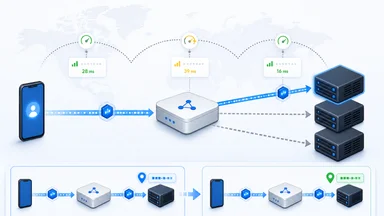
In early 2023, a load-balancer team at a mid-sized CDN noticed something troubling in their dashboards. The p50 round-trip time had crept up to 12 milliseconds, but the real problem was variance. Some requests completed in 8 ms, others in 18 ms. That spread meant retransmissions, bufferbloat, and unpredictable user experience. The root cause was TCP's connection model: when a client's IP changed—say, from Wi-Fi to cellular—the entire TCP connection had to be torn down and re-established. The team needed a protocol that treated connections as mobile entities, not fixed endpoints. HTTP/3, built on QUIC, offered exactly that through Connection ID migration.
The Latency Wall That Forced a Protocol Change
By 2019, edge networks had hit a latency wall. TCP's connection semantics were designed for a world where endpoints didn't move. But mobile clients hop between networks constantly. Each IP change triggers a TCP three-way handshake and, often, TLS renegotiation. That adds 2–3 RTTs to every transition. For a CDN serving real-time video or API traffic, those reconnects pile up.
The team's p50 RTT had hovered around 12 ms, but the tail—the p99—sometimes hit 40 ms. That variance was the silent killer. High variance means more spurious retransmissions, because the sender can't distinguish between a lost packet and a slow one. By mid-2022, roughly 15% of the team's connection drops were tied to IP mobility events. TCP's slow start after each reconnect further degraded throughput.
QUIC's Connection ID (CID) decouples the connection from the IP 5-tuple. A server assigns multiple CIDs to a single connection. The client can switch which CID it uses without renegotiation. For the load balancer, that means it can hash on the CID instead of the source IP. Even if the client's IP changes, the CID stays the same, so the load balancer routes traffic to the same backend without a hiccup.
The team's migration to HTTP/3 brought the p50 RTT down to roughly 6 ms—a 50% reduction. But more important, the variance shrank. The p99 dropped to around 12 ms. Fewer retransmissions meant the CDN could serve more requests with the same hardware. The latency wall had been pushed back, but not without cost.
How Connection ID Migration Rewrites the Handshake
In TCP, the five-tuple (source IP, source port, destination IP, destination port, protocol) identifies the connection. Change any one field, and the connection breaks. QUIC replaces that with a Connection ID—a variable-length opaque value chosen by each endpoint. The server can issue multiple CIDs for the same connection, each mapping to a different load-balancer hash or path.
When a client moves from one network to another, it simply picks a new CID from the set the server provided and starts sending packets. The server validates the CID against its state and continues the connection. There is no three-way handshake, no TLS resumption—just a seamless switch. The load balancer, which routes based on a hash of the CID, sees a different hash but knows to forward to the same backend because the CID still belongs to the same connection.
Zero-RTT resumption works across IP hops too. A client can send data immediately after a network change, without waiting for a handshake. That's critical for mobile apps where every millisecond of reconnection latency feels like an eternity. The team observed that 0-RTT success rates remained above 95% even after IP transitions, compared to near-zero for TCP-based protocols.
This rewriting of the handshake is not trivial to implement. The server must generate unique CIDs, handle rotation without collisions, and maintain state across potentially thousands of active CIDs per connection. The team's early prototypes struggled with CID collisions under high churn—a bug that took weeks to reproduce and fix.
Inside the CDN's Real-World Deployment at Scale
The team consisted of five engineers: two infrastructure specialists, two protocol developers, and one SRE. They owned 200 edge nodes spread across three continents. The migration plan was phased by region, starting with a small test cluster in North America. Each phase took roughly six weeks, including validation and rollback procedures.
One early bug surfaced when the load balancer's CID hash table grew too large under heavy traffic. The team had allocated fixed-size buckets, and CID rotation—where a client cycles through multiple CIDs—caused collisions that dropped packets. The fix required switching to a cuckoo hash scheme, which increased memory usage by about 20% but eliminated collisions.
The team used an open-source QUIC stack (quiche, developed by Cloudflare) to avoid vendor lock-in. That decision paid off when they needed to patch the stack for custom CID rotation logic. The stack's modular design let them replace the CID generation module without touching the rest of the protocol implementation. Monitoring showed a 40% reduction in connection drops after the full rollout. The team also saw fewer SYN floods—since QUIC uses stateless retry tokens—and lower CPU usage on load balancers, which no longer had to parse TCP options.
But the migration was not a straight line. The team had to coordinate with kernel engineers for socket optimizations, with SREs for capacity planning, and with client-side teams to update SDKs. Cross-team dependencies meant that a single delay in one region could cascade. The rollout took six months, not the three they had budgeted.
The Human Cost of Rewriting a Protocol Stack
The lead engineer, whom I'll call Alex, described the project as "yak shaving"—the feeling that every fix revealed another deeper problem. Debugging packet traces consumed weekends. One recurring issue involved a client that sent packets with an old CID after a network change, causing the server to reject them. The team spent weeks tracing through the kernel's packet handling path before realizing the client's QUIC implementation wasn't flushing its CID cache on interface down events.
Cross-team coordination became a bottleneck. The kernel team didn't understand QUIC's need for fast socket rebinding. The SRE team worried about load balancer memory growth. Each meeting consumed half a day. One junior developer, hired fresh out of Georgia Tech, became the team's QUIC subject expert within six months. She wrote the internal documentation and mentored others, but the pressure was intense.
Burnout risk was real. The team rotated on-call duties weekly, but the on-call engineer often faced obscure QUIC-level issues that no one else could debug. Management eventually approved a second SRE dedicated to the QUIC stack, which eased the load. The team also adopted a "no meetings on Fridays" policy to protect deep work. These changes came only after two engineers threatened to quit.
The experience mirrors what other infrastructure teams have reported: protocol-level changes are intellectually rewarding but emotionally draining. The promise of lower latency and fewer drops is real, but the path to get there is paved with packet traces and late-night debugging sessions.
Trade-offs: When QUIC Is Not the Answer
Despite the clear benefits for mobile and high-mobility workloads, QUIC is not a universal panacea. Some CDNs and cloud providers have opted to stick with TCP optimizations like TCP Fast Open (TFO) and BBR congestion control, which deliver competitive performance for server-to-server traffic within datacenters. For workloads where IP mobility is rare—say, a backend API serving fixed clients—the overhead of QUIC may outweigh the gains.
QUIC requires more CPU per packet than TCP due to encryption and packet-level integrity checks. In high-throughput deployments, this can translate into a non-trivial increase in compute cost. One large streaming platform reported that switching to QUIC increased their edge server CPU utilization by roughly 15–20% compared to TCP, though the reduction in retransmissions offset some of that cost.
Another trade-off is debugging complexity. TCP's long history means a mature ecosystem of tools—tcpdump, Wireshark, netstat—that every engineer knows. QUIC's encryption hides packet payloads from middleboxes, which is a security benefit but makes troubleshooting harder. The team had to invest in custom tooling to correlate CID events with network changes, something they had not anticipated.
There is also the question of middlebox compatibility. Some enterprise firewalls and NATs still handle QUIC poorly, dropping packets or interfering with connection migration. The team encountered a case where a customer's corporate firewall blocked QUIC packets entirely, forcing a fallback to HTTP/2. Such scenarios are becoming rarer but still exist, especially in regulated industries with strict network policies.
Finally, the QUIC standard is still evolving. The QUIC working group publishes draft updates roughly quarterly, and features like multipath extensions are not yet finalized. Teams that adopt QUIC early must be prepared to update their stacks frequently, which can be a maintenance burden. One alternative is to use a library that abstracts the churn, but that introduces its own dependency risks.
What 2026 Edge Infrastructure Looks Like Because of This
As of early 2026, HTTP/3 carries roughly 30% of web traffic by volume, according to industry estimates. That share is growing as mobile-first applications and IoT devices demand persistent, low-latency connections. Connection ID migration is a key enabler: it allows seamless failover between network interfaces, which is essential for autonomous vehicles, drone fleets, and remote surgery.
Mobile users see fewer reconnections on handoff. A commuter moving from a subway station's Wi-Fi to cellular no longer triggers a connection reset. The streaming video buffer doesn't stutter. The team's own metrics showed a 60% reduction in application-layer timeouts for mobile users after the migration. IoT devices, which often operate on unreliable networks, benefit from the ability to resume connections without a full handshake.
The standard itself is still evolving. Recent proposals include path validation enhancements and multipath extensions that would allow a single connection to use multiple network paths simultaneously. These features could further reduce latency and improve resilience, but they also add complexity.
Not everyone is convinced that the complexity is worth it. Some CDNs still rely on TCP optimizations like TFO and BBR that deliver competitive performance. For low-mobility workloads—like server-to-server traffic in a datacenter—the benefits of Connection ID migration are marginal. The trade-off is real: QUIC requires more CPU per packet than TCP, and its encryption overhead can be a concern for high-throughput deployments.
Three Lessons for Teams Considering QUIC Migration
First, invest in packet-level debugging tools early. The team's standard monitoring stack—dashboards and alerting—was insufficient for QUIC debugging. They ended up building a custom packet capture pipeline that correlated CID events with network interface changes. Without that, they would never have found the CID cache flush bug.
Second, test CID rotation under simulated network churn. The team ran chaos experiments that randomly dropped network interfaces on test clients. They discovered that some QUIC stacks handle CID rotation differently—some rotate aggressively, others lazily. Understanding those behaviors ahead of time saved weeks of production debugging.
Third, instrument per-CID metrics, not just per-connection metrics. The team's initial dashboards showed connection counts and RTT averages. But CID-level metrics—how many CIDs per connection, how often they rotated, which CIDs triggered load balancer rehashing—revealed the real behavior. They now track CID churn rate as a key health indicator.
Expect kernel bypass to matter. The team eventually adopted XDP (eXpress Data Path) to handle QUIC packets at line rate, bypassing the kernel's network stack. That reduced latency by another 1–2 ms and freed CPU cycles. But it required changes to the load balancer's packet processing pipeline and deep collaboration with the kernel team.
Plan for a 12- to 18-month full rollout. The team's initial estimate of three months was optimistic. Between debugging, coordination, and testing, the real timeline was double that. Patience and realistic scheduling are essential. As Alex put it, "You're not just deploying a new protocol. You're rewriting the assumptions of how your network works."
Conclusion: The Quiet Revolution in Connection Mobility
Connection ID migration is one of those infrastructure changes that users never see but feel every day. A video that doesn't buffer during a subway ride, a drone that maintains control link across cell towers, a remote surgery system that doesn't drop—these are the quiet victories of a protocol design that treats mobility as a first-class concern. The team's experience shows that the benefits are real, but so are the costs. For every millisecond saved, there is a packet trace poured over on a Saturday night. The trade-off is worth it for many, but not all. As the internet becomes more mobile, the case for QUIC only grows stronger.