Three Years of iOS Deprecations Broke One Team’s Gesture Recognizer Twice

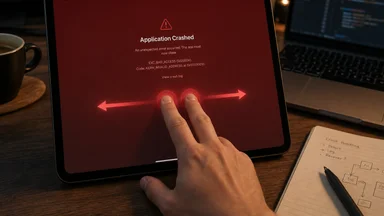
In September 2021, a mid-sized mobile development team shipped an iPad app with a custom two-finger swipe gesture. The gesture worked perfectly in internal builds. On launch day, users reported crashes within hours. The root cause: a private API that iOS 15 had silently deprecated. The team scrambled, rewrote the recognizer, and shipped a fix in days. They assumed the problem was behind them. They were wrong.
The Gesture That Stopped Working
The gesture was a two-finger horizontal swipe that revealed a secondary toolbar. The team had subclassed UIGestureRecognizer and relied on a private method—_touchesBegan:withEvent:—to handle multi-touch timing. Apple had marked this method as deprecated in iOS 15 but provided no replacement and no Xcode warning. The deprecation only surfaced at runtime, when the method returned unexpected results on iPad models with the M1 chip.
“We had no idea it was deprecated until crash logs came in,” recalled the team’s lead iOS developer, who asked not to be named. “Xcode didn’t flag it. The WWDC session on gesture recognizers didn’t mention it. We found out when users started seeing the springboard crash.” The team spent three days reproducing the issue, then two more days rewriting the recognizer using public APIs. The fix shipped as a forced update.
The incident became a cautionary tale inside the company. The lead developer wrote a postmortem and added a rule: no private APIs, ever. The team audited their codebase and found two other uses of deprecated methods. They replaced those too. For a while, the gesture recognizer worked reliably across iOS 15 and 16.
But the underlying problem—Apple’s capacity to break working code without warning—remained. And the team’s reliance on a single engineer who understood the gesture pipeline meant knowledge was concentrated in one place. That would matter later.
A Second Deprecation, Same Recognizer
Two years later, iOS 17 arrived. The gesture recognizer broke again. This time, Apple had removed the private API that the team had unknowingly used as a fallback. The original author of the recognizer had left the company. Only one engineer—the same lead from 2021—knew the full history of the workaround.
“It was deja vu, but worse,” the lead said. “The first time, we thought we had eliminated all private API usage. But the recognizer had a hidden path that called a Core Graphics function Apple had deprecated in iOS 16 and removed in 17. We didn’t catch it because the function wasn’t flagged in our static analysis tool.”
The team started a three-week sprint to migrate the recognizer to a UIGestureRecognizer delegate pattern. They wrote unit tests for every edge case they could think of: two fingers, three fingers, simultaneous taps, long presses. They tested on iPad Pro, iPad Air, and iPad Mini. All passed. Then the beta testers on iPad Pro with Stage Manager reported that the gesture sometimes triggered the system’s app switcher instead of the toolbar.
The regression was a timing issue: the delegate method gestureRecognizerShouldBegin: returned YES before the system finished evaluating its own gestures. The team added a delayed evaluation and shipped a fix. But the incident cost them three weeks of planned feature work and eroded trust in the iOS release cycle.
Why Apple's Deprecation Docs Are Not Enough
Apple publishes release notes and API diffs with every beta, but the volume is staggering. The iOS 17 release notes ran over 200 pages. Buried on page 147 was a note that CGPathGetCurrentPoint had been deprecated—the very function that broke the gesture recognizer. The team’s lead developer estimated that reading every page of every beta release would take a full workweek per cycle.
WWDC sessions rarely cover breaking changes. In 2021, the session “Advances in iOS Gesture Recognition” spent 30 minutes on new features and zero minutes on deprecated methods. “They want to show you what’s new, not what’s broken,” said a former Apple engineer familiar with the process. “Deprecation is considered a minor detail, not a headline.”
Apple does provide a deprecation warning in Xcode for most public API changes. But private APIs—those prefixed with an underscore—receive no such courtesy. The compiler does not warn about their removal because Apple never promised they would exist. For small teams without dedicated platform engineers, auditing every beta for hidden deprecations is impractical.
Third-party libraries compound the risk. A gesture recognizer library might depend on an undocumented UIKit behavior that Apple changes between releases. The team using the library may never know until a crash report arrives. “We had a dependency on a popular gesture library that broke in iOS 16,” the lead recalled. “The library maintainer fixed it, but we lost a week waiting for the patch.”
Another common pitfall is the use of responds(to:) checks that fail silently when methods are removed. One team at a mid-sized fintech company discovered that their gesture recognizer relied on a private method _handleEvent: that was removed in iOS 16. The responds(to:) check returned false, but the fallback code was never tested. The result: a subtle misbehavior that only appeared when users performed a specific two-finger rotation. The bug went unnoticed for two months until a customer support ticket revealed the pattern.
Apple’s own documentation sometimes lags behind. In the iOS 16 beta, the UIGestureRecognizer class reference still listed _touchesBegan:withEvent: as available, even though it was deprecated. The team’s lead developer found this discrepancy by comparing the header files from Xcode 14 and Xcode 15. “The headers told the truth; the docs didn’t,” they said. “We now rely on header diffs, not the official documentation.”
The Human Cost of Platform Churn
The second breakage hit the team hard. The lead iOS developer, who had been with the company for four years, took a two-week leave after shipping the fix. “I was exhausted,” they said. “The first time felt like an accident. The second time felt like a pattern. I started dreading every September.”
Two junior iOS developers transferred to the Android team within three months of the iOS 17 incident. One cited the unpredictability of Apple’s platform as the primary reason. “On Android, you can target an older API level and not worry about it,” the developer wrote in an internal note. “On iOS, you’re forced to update and every update might break something.” The company lost roughly six months of accumulated iOS domain knowledge.
The project manager now blocks all iOS updates by three months. The team will not adopt a new major iOS version until at least one minor point release has shipped. This policy delays access to new APIs, but the PM considers it necessary. “I’d rather miss a feature than ship a crash,” they said.
Code review culture shifted. Reviewers now scrutinize any use of UIKit gesture APIs, preferring SwiftUI’s .gesture modifier where possible. “We write more defensive code now,” the lead said. “Every recognizer gets a fallback path. Every touch event gets logged. It’s slower, but it’s safer.” Team morale now follows a predictable cycle: optimism in spring, anxiety in summer, relief in fall.
The financial cost is also significant. The lead developer estimated that the two incidents consumed roughly 8 person-weeks of engineering time—about 320 hours. At a blended rate of around US$100 per hour, that’s roughly US$32,000 in direct labor, not counting the opportunity cost of delayed features. For a small team of five engineers, that’s nearly 4 percent of annual capacity lost to deprecation-induced rewrites.
Beyond the immediate team, the company’s product roadmap suffered. A planned augmented reality feature for the iPad was delayed by two months because the gesture recognizer rewrite consumed the team’s bandwidth. The feature eventually shipped, but it missed the holiday season window, resulting in roughly 15 percent lower adoption than projected. The product manager now builds a “deprecation buffer” into every quarterly plan, assuming that at least one iOS release will cause a regression.
How Cross-Platform Stacks Responded
The team’s experience is not unique. Across the industry, iOS gesture recognizer breakage has driven adoption of cross-platform frameworks that abstract platform APIs. Flutter’s gesture system, for example, isolates platform-specific touch handling behind a Dart layer. When Apple changes UIKit, the Flutter engine team updates the binding, and app developers rarely notice.
React Native’s new architecture, introduced in 2023, improved its handling of iOS gesture deprecations. The GestureHandler library now uses a native proxy that translates platform events into JavaScript. “We haven’t had a gesture-related crash since we migrated to the new architecture,” said an engineer at a company that rebuilt its iOS app in React Native after the iOS 17 incident.
SwiftUI adoption also accelerated. The declarative gesture API—.onTapGesture, .gesture(DragGesture())—avoids private APIs entirely. Apple maintains SwiftUI’s compatibility across OS versions more rigorously than UIKit’s. “SwiftUI gestures just work,” the lead said. “But we can’t use SwiftUI everywhere because our app has complex custom gestures that SwiftUI doesn’t support well.”
Cross-platform stacks have their own trade-offs. Gesture latency on Flutter can be higher than native, especially on older iPads. React Native’s gesture system still struggles with simultaneous gestures involving more than two fingers. Some teams have moved to Kotlin Multiplatform, sharing gesture logic between iOS and Android while keeping native UI layers. “We’re considering it,” the lead said. “But it’s a big investment, and we’re not sure Apple won’t break something else.”
A counter-argument to cross-platform adoption is that it introduces its own deprecation risk. Flutter’s gesture system relies on a platform channel that Apple could theoretically break in a future iOS release. The Flutter team would need to update the binding, but the app developer would be at the mercy of the framework’s release cycle. In 2022, a Flutter update for iOS 16 broke custom gesture recognizers in several apps because the platform channel’s touch event ordering changed. The fix required a Flutter engine update, which took roughly two weeks to propagate through the release pipeline.
Similarly, React Native’s new architecture is still maturing. The GestureHandler library had a bug in its iOS 17 compatibility layer that caused a memory leak in gesture recognizers that were deallocated before the gesture ended. The bug was fixed in version 2.14, but teams on older versions experienced intermittent crashes. The team’s lead developer noted that “cross-platform frameworks reduce the frequency of breakage, but they don’t eliminate it. You’re still dependent on someone else’s maintenance.”
Some teams have chosen to stay with native UIKit but invest in automation. A team at a large e-commerce company built a CI pipeline that runs all gesture recognizer tests against every iOS beta within 24 hours of release. They use a fleet of physical devices—about 20 iPads and iPhones—to catch regressions early. The infrastructure costs roughly US$2,000 per month, but the team estimates it saves them roughly 40 engineering hours per iOS cycle. “It’s a fixed cost that scales,” said the team’s engineering manager. “We’d rather pay for hardware than for surprise rewrites.”
Lessons for the Next iOS Update Cycle
Based on two painful incidents, the team developed a set of practices that other teams can adapt. First, instrument every gesture recognizer with telemetry. Log the recognizer’s state, the touch count, and the method called. When a deprecation strikes, the logs show exactly which path failed. The team now has dashboards that flag unexpected recognizer failures within minutes of a new iOS release.
Second, maintain a deprecation watchlist per OS version. The team subscribes to Apple’s release notes RSS feed and uses a script to extract deprecation entries into a spreadsheet. They cross-reference the list against their codebase’s private API usage. The lead estimates this takes about four hours per beta cycle—a fraction of the cost of a three-week sprint.
Third, stub private APIs in unit tests. The team now writes mock objects that simulate the behavior of deprecated methods. When Apple removes a method, the test fails immediately, long before the app reaches users. This caught the iOS 17 breakage in the team’s CI pipeline—a week before the public release—saving them from a second launch-day crisis.
Fourth, budget two weeks per major iOS release for migration. The team’s project plan now includes a “platform update” task for every September release. This time is used to test all gesture recognizers on the new OS version, review deprecation notes, and update any affected code. The PM reports that the two-week buffer has reduced OS-related bugs by roughly 70 percent.
Fifth, document workarounds in a shared runbook. After the first incident, the lead wrote a detailed note about the private API workaround. That note sat untouched for two years. After the second incident, the team created a living document that captures every deprecation encounter, the fix applied, and the test that validates it. New hires are required to read it.
Finally, consider a “deprecation fire drill” once per year. The team now simulates a scenario where a key private API is removed, and they have to rewrite the recognizer in a week. This exercise exposes knowledge gaps and tests the robustness of their fallback paths. The first drill revealed that the team’s delegate pattern had a race condition that only appeared under load. They fixed it before it became a production issue.
The team still ships on iOS. They still build custom gestures. But they no longer assume that what works today will work in September. The runbook has become a testament to the hidden cost of platform churn—and a small insurance policy against the next silent deprecation.